The last of the three related-rate geogebra problems from Kate Nowak. It's the related rate problem from calculus: the conical tank being filled with water.
Adjust the slider and... wait, what is changing and how?
For every click of the slider:
Is the depth increasing at a constant rate?
Is the radius increasing at a constant rate?
Is the volume increasing at a constant rate?
How can you tell?
Where or how, in the RealWorldtm, could we see the constant increase in volume?
Where or how, in the RealWorldtm, could we see the constant increase in radius, or depth?
We've all seen this problem, but many of our students haven't. It's the related rate problem from calculus: the balloon being filled with air.
There are two questions being demonstrated here.
(1) "If the volume increases at a constant rate, what is happening to the radius?" and
(2) "If the radius increases at a constant rate, what is happening to the volume?"
The first question is to figure out which situation is modeled in red and which in blue.
Then we can ask:
Does the radius increase at a constant speed in both models? How can you tell?
Does the volume increase at a constant speed in both models? How can you tell?
Where or how, in the RealWorldtm, could we see the constant increase in volume?
Where or how, in the RealWorldtm, could we see the constant increase in radius?
As we all know, the questions in an SAT test get harder as you get to the end of a section. I warn my students repeatedly that, at the end of a section,
"If you can't see what all those people thought was the obvious answer and clearly see why that obvious answer is wrong, then you are one of those who will jump to the wrong conclusion ... and you'll get it wrong, too."
You see, the question at the end aren't really difficult usually. They can be badly worded but they're rarely HARD. They are usually four-step problems that everyone else is so sure about, and the answer is so obvious that they get suckered in. These two were rated the same level of difficulty, and were answered correctly by about 3%-5% of the students.
Which one is harder?
25. A woman
drives to work each day at an average speed of 40 miles per hour and returns
along the same route at 30 miles per hour. If her total traveling time was 1
hour, what was the total number of miles in the trip?
30
$30\dfrac{1}{7}$
$34\dfrac{2}{7}$
35
40
24. A 25 foot ladder is placed against a vertical
wall of a building with the bottom of the ladder standing on concrete 7 feet
from the base of the building. If the
top of the ladder slips down 4 feet, then the bottom of the ladder will slide
out.
The man is walking down the sidewalk in the evening, at a constant speed. As he walks away from the streetlight, he casts a shadow in front of him.
If a second man were to try and keep up with the very front tip of his shadow, would he be walking at a constant speed, accelerating or decelerating, or what?
If it takes me 60 minutes to cook dinner by myself, and 90 minutes if one of my kids is "helping" me, how long would it take her to do it herself?
— Matt Enlow (@CmonMattTHINK) May 10, 2014
How long would it take everyone in your school to recite it?
272 words (or 269, depending on how you count, and which version you use.)
On November 19th Lincoln traveled to
Gettysburg to dedicate the new Union Cemetery
The featured speaker was Edward Everett of Massachusetts, a diplomat, clergyman,
and celebrated orator. The president had been invited
almost as an afterthought to offer a few appropriate remarks. Everett spoke for
not quite two hours.
Then Lincoln rose. The local photographer took his time
focusing; presumably the president could be counted on to go on for a while ... but he spoke just 269 words.
He started off by reminding his audience
that just 87 years had passed since the founding of the nation and then he went on to embolden the
Union cause with some of the most enduring words ever
spoken.
Lincoln was heading back to his seat
before the photographer could open the shutter.
He felt that he had failed, that it was a poor speech, that people
didn't like it. It was so brief, less than two minutes, he felt that he had
failed. His friend, Ward Lehman, was sitting next to
him on the stand when he sat down and there was just a sprinkling of applause.
He said "Lehman, that speech won't scour." That's what you say about the plow in the prairies when the mud won't come off it."
"The cheek of every American must tingle with shame when he reads the flat, silly, dish watery utterances of the man who has
to be pointed out to intelligent foreigners as the president of the united states."
Chicago Sun-Times
"Dear Mister President, I should be glad if I could flatter
myself that I came as near to the central idea
of the occasion in two hours as you did in two minutes." - Edward Everett
President Lincoln delivered the 272 word Gettysburg Address on November
19, 1863 on the battlefield near Gettysburg, Pennsylvania.
"Fourscore and seven years ago our fathers
brought forth, on this continent, a new nation, conceived in liberty,
and dedicated to the proposition that all men are created equal. Now
we are engaged in a great civil war, testing whether that nation,
or any nation so conceived, and so dedicated, can long endure. We
are met on a great battle-field of that war. We have come to dedicate
a portion of that field, as a final resting-place for those who here
gave their lives, that that nation might live. It is altogether fitting
and proper that we should do this. But, in a larger sense, we cannot
dedicate, we cannot consecrate—we cannot hallow—this ground.
The brave men, living and dead, who struggled here, have consecrated
it far above our poor power to add or detract. The world will little
note, nor long remember what we say here, but it can never forget
what they did here. It is for us the living, rather, to be dedicated
here to the unfinished work which they who fought here have thus far
so nobly advanced. It is rather for us to be here dedicated to the
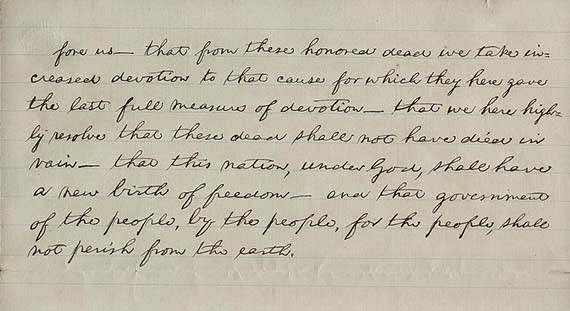
great task remaining before us—that from these honored dead
we take increased devotion to that cause for which they here gave
the last full measure of devotion—that we here highly resolve
that these dead shall not have died in vain—that this nation,
under God, shall have a new birth of freedom, and that government
of the people, by the people, for the people, shall not perish from
the earth."
The 7.6-mile-long Mt. Washington Road is lined with trees, drop-offs, and winds on the way to the 6,288-foot summit. Travis Pastrana in a 2011 Subaru Impreza WRX STI rally car, with an officially timed run of 6 minutes 20.47 seconds.
There are questions all over the place.
Average speed
Average slope of the road.
What do the calls mean?
Add more in the comments.
This one includes rally notes system details. "Increases the radius, decreases the radius" "Can you take it wide open?" "If the notes are wrong, we go off a cliff."