Showing posts with label Pre-Calculus. Show all posts

Monday, December 1, 2014

328: Which values of x do we choose? Conics

For the following functions, think about "How to graph like a math teacher." Math teachers want to sketch graphs quickly and efficiently and choose values of x that work "nicely" in the equation and  generate integer values of y, thus making it easier to graph.
  • Which points are best found by inspection?
  • Which points are best found by substitution?
  • Which points are best found by symmetry?

$x^2+y^2=25$ 

$\dfrac{(x-1)^2}{9}+\dfrac{(y+2)^2}{16} = 1$

$\dfrac{(x-4)^2}{9}-\dfrac{(y-4)^2}{16} = 1$


What are your favorite examples of this?

Wednesday, September 10, 2014

246: Square and Circle


Two opposite vertices of a square lie on a circle. Sure as sunrises, someone is going to ask about area.


What information do we need?

What would be the easiest scenario?

Is there more than one easy scenario?

source.

Monday, August 25, 2014

228: Four Intersections

Find two polynomials whose four points of intersection form a perfect square. (...with integer coefficients?)

What's the best way to do that?


.
.

Thursday, August 14, 2014

217: Twelve dots and triangles

Here are twelve dots equally spaced around a circle. There are two triangles created by connecting three of the dots.
  1. Which three dots will give the triangle with the LARGEST area? 
  2. Which three dots will give the triangle with the SMALLEST area?


Challenge:
What are those two areas?

Source: https://solvemymaths.wordpress.com/ 

Tuesday, July 29, 2014

201: Circles and Pentagon

Two circles, radius 1 (each does not pass through the others center).
All seven regions are of equal area.
What is the area of the pentagon?


Friday, July 25, 2014

197: Polar Figures 6

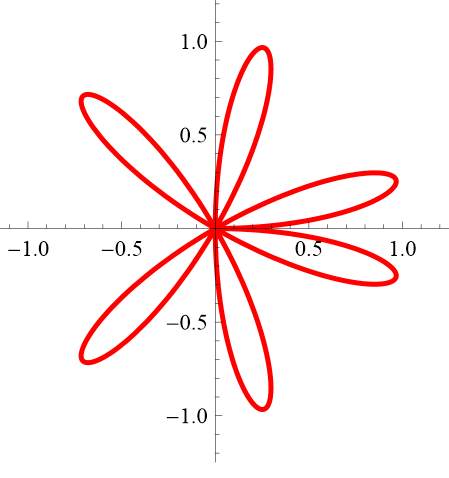
Can you recreate these figures? Note: Unlike the previous figures, these are all "incomplete" so you will have to do two things ... (a) figure out the form of the full figure (how many pedals, etc.) and (b) restrict the domain appropriately.  In Desmos, domain restriction is done this way:


Here we go ....


Thursday, July 24, 2014

Tuesday, July 22, 2014

194: Polar Figures 3

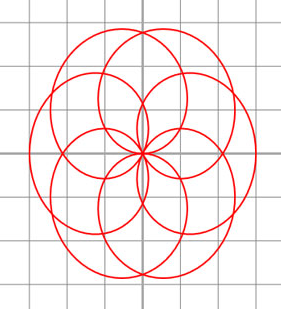
Can you recreate these figures?

Single function.

In Desmos or Plot.ly, Create this Family of functions.


Monday, July 21, 2014

193: Polar Figures 2

Can you recreate these figures?


This last one is a piece-wise function ...


Wednesday, July 16, 2014

Wednesday, June 11, 2014

151: Medieval Altitude Measurement

Explain the reasoning used in 1588 to find the height of the castle.

So they could shoot it.


Saturday, May 3, 2014

119: Area of Triangles

From the Amazingly Amazing Fake Martin Gardner Twitter Account:

Which has the larger area?
  • A triangle with sides of 3, 4, and 5.
  • A triangle with sides of 300, 400, and 700.
Challenge
  • Change one dimension of the 300, 400, 700 triangle to give the two triangles the same area.

Tuesday, April 29, 2014

114: Square Root Exponents

We all know that adding/subtracting exponents corresponds to multiplying/dividing the terms, like this:

$x^4 * x^7 = x^{11}$

$\dfrac{x^{14}}{x^9} = x^5$

Then negative exponents logically followed: $x^{-7} = \dfrac{x^2}{x^9}$

Then $\dfrac{x^3}{x^3} = x^0 = 1$ logically followed that. 

Additionally, multiplying/dividing the exponents relates to powers/roots

$ {x^4}^2 = x^{4*2} = x^8$

$\sqrt{x^6} = x^{6/2} = x^3$

So a fractional exponent means a radical, depending on the denominator of the exponent.

So here's my question:


What should we think about $x^{\sqrt{2}}$

How should we interpret that?

Saturday, March 1, 2014

44: Can two different fractions be the same?

From Gabriel Rosenberg via email:

True or False?
Two-thirds and four-sixths are the same number.

To see why this is tagged Pre-Calculus and Complex Numbers, please see the comments.