Showing posts with label Calculus. Show all posts
Showing posts with label Calculus. Show all posts
Tuesday, April 16, 2019
519: Concavity
I have a question that will help me understand the fundamental definition of concavity. If we have y=x^4, can we say that is concave up from (-inf, +inf) or do we need to say (-inf,0)U(0,+inf)?

Sunday, November 22, 2015
506: The Conical Tank

Adjust the slider and... wait, what is changing and how?
For every click of the slider:
Is the depth increasing at a constant rate?
Is the radius increasing at a constant rate?
Is the volume increasing at a constant rate?
How can you tell?
- Where or how, in the RealWorldtm, could we see the constant increase in volume?
- Where or how, in the RealWorldtm, could we see the constant increase in radius, or depth?
If you want to play with the animation, Conical Tank Problem. source: @k8nowak
505: The Balloon Problem

There are two questions being demonstrated here.
(1) "If the volume increases at a constant rate, what is happening to the radius?" and
(2) "If the radius increases at a constant rate, what is happening to the volume?"
The first question is to figure out which situation is modeled in red and which in blue.
Then we can ask:
- Does the radius increase at a constant speed in both models? How can you tell?
- Does the volume increase at a constant speed in both models? How can you tell?
- Where or how, in the RealWorldtm, could we see the constant increase in volume?
- Where or how, in the RealWorldtm, could we see the constant increase in radius?
If you want to play with the animation, Balloon Problem. source: @k8nowak
Friday, November 6, 2015
504: The Ladder Problem

We've all seen this problem, but many of our students haven't.
It's the related rate problem from calculus: the ladder sliding down the wall.
The "official" question?
How fast is the ladder's top sliding down the wall if the bottom is being pulled out at a rate of 1 ft/sec?
We can ask a few questions of kids at any level, though, based on the given that the bottom of the ladder is being pulled to the left at 1 foot per sec.
- Does the top drop at a constant speed?
- Does the top drop a distance equal to the horizontal movement?
- When is the speed of the top greater than 1, less than 1, and equal to 1?
- If this is a 25 foot ladder, with the bottom 7 feet out from the base of the wall, and the top drops 4 feet ... how far out does the bottom of the ladder have to go?
If you want to play with the animation, Ladder Problem. source: @k8nowak
Sunday, April 5, 2015
422: Inscibed Semicircle, part three
Last question with this visual:
How could you draw the inscribed semicircle (area = π) so that the rectangle is of maximum size?

How could you draw the inscribed semicircle (area = π) so that the rectangle is of maximum size?
A semicircle is inscribed in a rectangle. If the area of the semicircle is π, area of rect=?
[4]
#SATPrep
#mathchat
#Geometry
— David Marain (@dmarain) March 26, 2015
Thursday, November 20, 2014

Sunday, September 14, 2014
250: The Shadow Knows

The man is walking down the sidewalk in the evening, at a constant speed. As he walks away from the streetlight, he casts a shadow in front of him.
If a second man were to try and keep up with the very front tip of his shadow, would he be walking at a constant speed, accelerating or decelerating, or what?
How do you know your answer is correct?
Monday, June 9, 2014
149: Medieval Ballistics
Tartaglia

Using the angle between line of sight to the projectile and the horizontal, show why the trajectory was considered to be in this shape for many centuries. (Hint: consider that only those viewing from BEHIND could see the projectile. UPDATE: Yes, those in front could see something coming. "I couldn't figure out what it was coming closer and closer ... then it hit me.")

This may be more than you want ... if so, pay no attention to the following instructions.
In Geogebra, graph the parabolic arc. We'll assume for simplicity that the cannonball begins at (0,0) and hits at (1000,0) with max at (500,250). In the input box, place y=x(x-1000)/1000. Place A at (-10,0) and B, a point on the object f(x). Place c(500,0) so we have three points. Create line segments AB and AC. Measure CAB. Drag B along the curve, paying attention to the angle. What do you see?
How does it change as you move B?
Using the angle between line of sight to the projectile and the horizontal, show why the trajectory was considered to be in this shape for many centuries. (Hint: consider that only those viewing from BEHIND could see the projectile. UPDATE: Yes, those in front could see something coming. "I couldn't figure out what it was coming closer and closer ... then it hit me.")
This may be more than you want ... if so, pay no attention to the following instructions.
In Geogebra, graph the parabolic arc. We'll assume for simplicity that the cannonball begins at (0,0) and hits at (1000,0) with max at (500,250). In the input box, place y=x(x-1000)/1000. Place A at (-10,0) and B, a point on the object f(x). Place c(500,0) so we have three points. Create line segments AB and AC. Measure CAB. Drag B along the curve, paying attention to the angle. What do you see?
How does it change as you move B?
 |  |
Tuesday, May 20, 2014

Saturday, April 12, 2014
94: Related Rates

Describe how the two trucks must work together throughout this turn.
Can the rear truck get whipped?
Thinking... Thinking... #wcydwt RT @eeportal_com: Dispatching wind turbine blade to the site! Amazing!
— Geoff Krall (@emergentmath) March 28, 2014
Tuesday, April 8, 2014
89: Approximately Three-fifths
Building on the previous few days ... if all vertical lines are equally spaced,
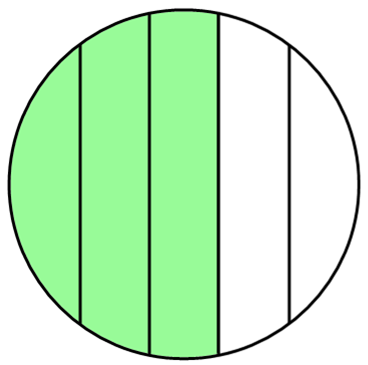


Which is closest to being three-fifths shaded?
Subscribe to:
Posts (Atom)