Showing posts with label Analysis. Show all posts

Wednesday, December 16, 2015

512: Factory Ratios 3

We started with this:
In a factory, the ratio of men to women is 2:3. The ratio of right-handed men to left-handed men is 7:3. The ratio of right-handed women to left-handed women is 11:1. What fraction of the factory workforce is right-handed?
And then we extended with: What is the fewest number of employees possible in this building?

If the ugly-sweater party was held in that factory with the minimum number of workers possible and the  ratio of red to green ugly sweaters was 7:13, how likely is it that a left-handed man wore a red ugly sweater?

Source:

511: Factory Ratios 2

We started with this:
In a factory, the ratio of men to women is 2:3.
The ratio of right-handed men to left-handed men is 7:3
The ratio of right-handed women to left-handed women is 11:1
What fraction of the factory workforce is right-handed?
But let's extend things a bit.

What is the fewest number of employees possible in this building?

Source:

Saturday, November 28, 2015

509: Circles 2

Several days ago, I posted a slightly different question about tangential circles and the spaces in between. Compare this question, from the 2004 SAT Practice Test to that question from Emma Bell.
  • Which question seems harder? What are the difficult aspects of each?
  • Do we have to specify the angle APB?
  • How are these two questions different in terms of the knowledge they require for solving?
  • Is this question made harder by the "how many times" part? Does that phrasing make the question unnatural?


source: ETS, 2004

508: Shorter Path


What car will have the shorter path?
How could you tell for certain?

source: Justin Aion

Friday, November 6, 2015

504: The Ladder Problem


We've all seen this problem, but many of our students haven't.

It's the related rate problem from calculus: the ladder sliding down the wall.

The "official" question?

How fast is the ladder's top sliding down the wall if the bottom is being pulled out at a rate of 1 ft/sec?

We can ask a few questions of kids at any level, though, based on the given that the bottom of the ladder is being pulled to the left at 1 foot per sec.

  • Does the top drop at a constant speed?
  • Does the top drop a distance equal to the horizontal movement?
  • When is the speed of the top greater than 1, less than 1, and equal to 1?
  • If this is a 25 foot ladder, with the bottom 7 feet out from the base of the wall, and the top drops 4 feet ... how far out does the bottom of the ladder have to go?

If you want to play with the animation, Ladder Problem. source: @k8nowak

Monday, October 19, 2015

498: Circles on a Lattice

On a square lattice, a circle can pass through 2, 3, or 4 points, as in the diagram below. The original question asks for a circle that passes through 5 points, but can you define a circle that passes through other numbers of points? and explain how the circle was created?

source:

Sunday, October 11, 2015

495: Pythagorean anti-Triples?


Ask your class if there are any Pythagorean anti-Triples: $\dfrac{1}{a^2} + \dfrac{1}{b^2} = \dfrac{1}{c^2}$ ?


If a, b, c are integers, the question seems harder, since 1/3, 1/4, 1/5 would be (to me) obvious answers - leading to the rules for Pythagorean triples and just using their reciprocals.

Source:

Sunday, September 27, 2015

492: Sneak in Some Algebra

Marilyn Burns pointed out:


Well, does it?
Is there a pattern that always works?


source.

Sunday, September 13, 2015

491: Discuss the Errors, part 2

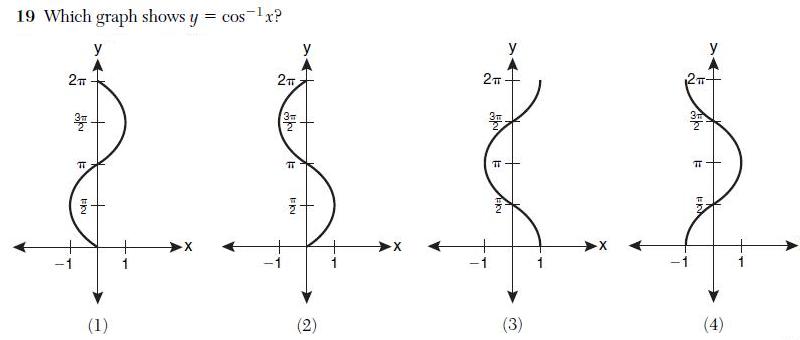
This question is from the NY Regents test, and discussed by Patrick Honner in his long-running series, "Are These Tests Any Good?".

Can your students find what is wrong with it?
How would they fix it?


source.

490: Discuss the Errors, part 1

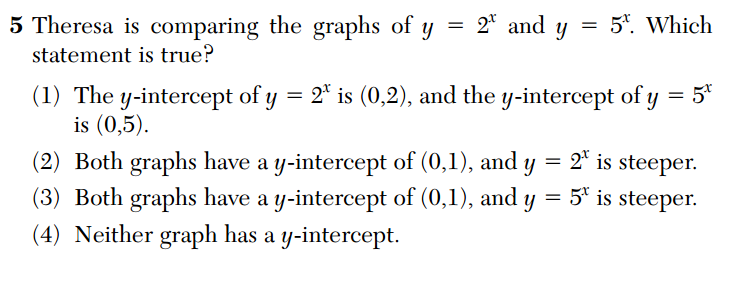
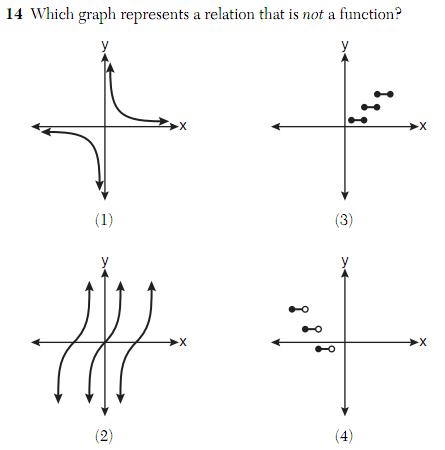
These questions are from the NY Regents test, and discussed by Patrick Honner in his long-running series, "Are These Tests Any Good?".

Can your students find what is wrong with them?


and


source.

Saturday, August 22, 2015

489: Which Quadratic Formula?

So ... I've seen a couple of YouTube videos that feature songs about the Quadratic Formula.  I often see it written like this:

$x = \dfrac{-b \pm \sqrt{b^2-4ac}}{2a}$

and it occurs to me that I've always written it this way:

$x = \dfrac{-b}{2a} \pm \dfrac{\sqrt{b^2-4ac}}{2a}$

Which one is better?

Thursday, July 16, 2015

487: The Fifteen Puzzle

Everyone older than ten knows that there is a way to play tic-tac-toe so that you can never lose. Any game that can be played to a draw unless someone makes a newbie's mistake, is boring once you know the secret.

Let's look at this one and see if you can find a strategy for it:


Players alternate writing a number from 1 - 9 (once used, it’s dead). First one with a set of three numbers that sum to 15 wins.

Is there a guaranteed winning strategy for Player 1?
Is there a guaranteed winning strategy for Player 2?

source:
How does his later comment help? "It’s equivalent to tic-tac-toe since any row/col/diagonal in a 3x3 magic square sums to 15, but more mathematically interesting."

486: The Bowling Pins Puzzle

Everyone older than ten knows that there is a way to play tic-tac-toe so that you can never lose. Any game that can be played to a draw unless someone makes a newbie's mistake, is boring once you know the secret.

Let's look at this one and see if you can find a strategy for it:


There are thirteen pins and the two players take turns bowling.When bowling, you can knock down any pin or two adjacent pins (but not two that are separated by a space) that you like.  The loser knocks over the last pin.

The gnome has bowled first, knocking down #2. How do you best play this game so that you are guaranteed to win?

If you go first, what is your best play?

source: Loyd's Encyclopedia, 1914.

Tuesday, June 2, 2015

Sunday, May 31, 2015

474: Fractional Understanding


What insights does a student need to have before this problem is solvable?

Friday, May 29, 2015

473: Overlapping Squares

I might have posted this puzzle before.

What do your students think? Can they generalize it?
What is the overlapped area?
source:

Sunday, May 17, 2015

465: Probability Machine

You've all seen Plinko and its variations.  Here's one:


This one has a normal curve drawn on the background. Should it be a normal curve or more triangular like the arrangement of the pins?

Would it still be in this shape if the pins were arranged in a rectangle?

Sunday, May 10, 2015

457: Codebreaker


What are the values of the letters that will allow you to go as far as possible?

How high can you go?

Is there a better way to solve this than just marching up the line, and guessing at the values for H, R, then for F, U, then for I, V and so on?

The original is below. Is this the best set of values?


source:

456: A and B

The problem speaks for itself.

Saturday, May 2, 2015

450: One-third of a triangle

You've been asked to shade one-third of this triangle.

And how do you know?
Here's a response:


  • Is this a valid way to get one-third of the triangle?
  • Does this technique require that we stipulate a right triangle?
  • Does this technique require that we stipulate an isosceles one?
  • Do the lines have to be parallel to each other?
  • Do the lines have to be parallel to a side for this to work? 
  • Perpendicular to a side for this to work?

  • How might we generalize this method (if it can be generalized)?

sources: